
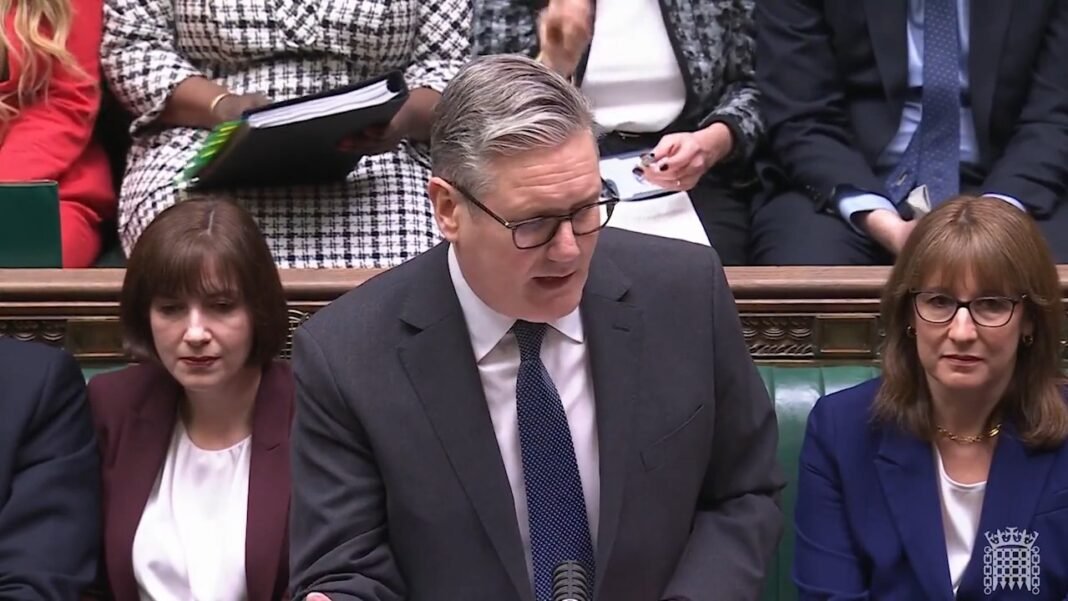
The Starmer Badenoch clash dominated Prime Minister’s Questions as tensions rose over the war involving Iran. Prime Minister Keir Starmer strongly criticised Kemi Badenoch during the heated exchange in Parliament.
The debate focused on Britain’s response to the conflict and the economic consequences for households. However, the Starmer Badenoch clash intensified when the prime minister accused the opposition leader of reversing her position.
Badenoch opened the session by questioning the government about petrol costs and fuel duty pressures. She asked why the government believed it was appropriate to increase petrol costs during international tensions.
Starmer quickly rejected that claim and insisted the government had not raised petrol prices. Instead, he explained that ministers are managing economic risks caused by instability in the Middle East.
Furthermore, Starmer said the government continues to work with allies to de-escalate tensions across the region. The prime minister then criticised Badenoch for earlier comments about military involvement in Iran.
He reminded MPs that he had decided Britain would not join the initial military strikes carried out by the United States and Israel. At the time, Badenoch had strongly criticised that decision and urged stronger support for allied operations.
However, Starmer argued that the Conservative leader changed her position soon afterward. He said Badenoch later told media outlets she had never supported joining the United States in military action.
Starmer described that change as the “mother of all U-turns” on a critical national security decision. The Starmer Badenoch clash continued as the prime minister accused opposition figures of retreating from earlier statements.
He also claimed that Badenoch and Nigel Farage had reacted nervously after the economic consequences became clearer. According to Starmer, both politicians initially supported military action before reconsidering their stance.
The prime minister also criticised Badenoch over comments about British military forces operating in the region. Last week, she suggested Royal Air Force jets were “just hanging about” in the Middle East.
Starmer condemned the remark and asked whether she would apologise for the statement. Meanwhile, the exchange highlighted wider political disagreements over Britain’s role in the crisis.
The government has prioritised diplomacy and international coordination to reduce tensions. Opposition figures, however, have argued that Britain should take a stronger position alongside its allies.
The debate also reflected concerns about rising fuel costs and economic pressure on British households. Ultimately, the Starmer Badenoch clash illustrated the growing political divide over foreign policy and economic strategy. As the conflict continues, similar confrontations in Parliament are likely to shape the national debate.
For more updates on this news, follow London Pulse News.