
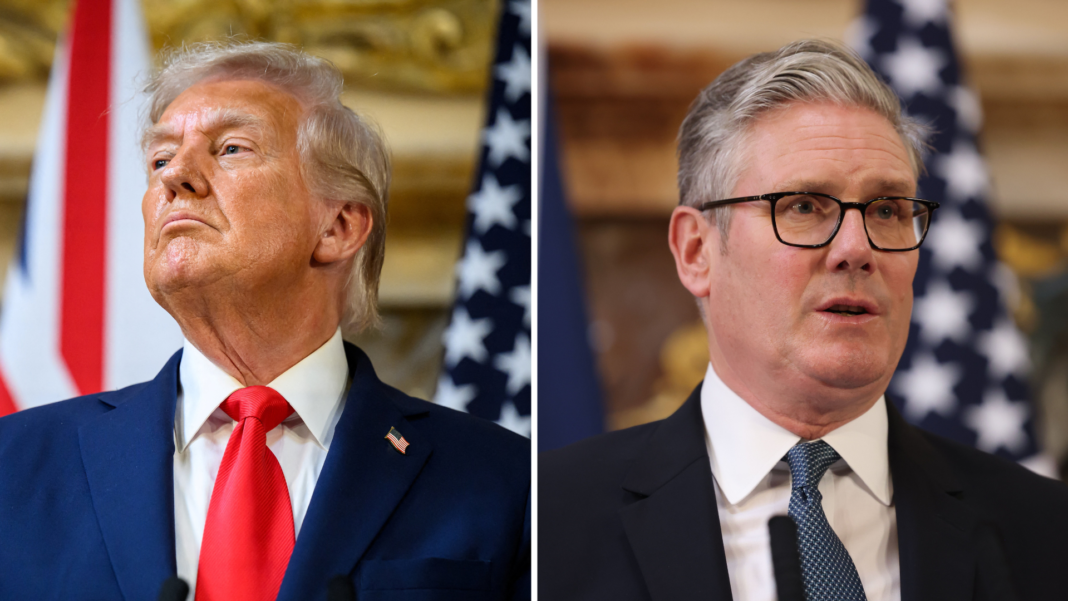
Prime Minister Keir Starmer and US President Donald Trump have discussed collective self-defence in the Middle East as tensions with Iran continue to escalate. The conversation followed criticism from Trump over Britain’s initial response to the conflict.
Earlier in the week, Trump criticised Starmer for refusing to allow the first wave of US military strikes against Iranian targets from UK bases. In addition, he mocked the prime minister by saying he was “not Winston Churchill”. Despite the criticism, both leaders later held talks about military cooperation and regional security.
A Downing Street spokesperson confirmed the two leaders spoke on Sunday afternoon. During the call, they discussed the latest developments in the Middle East and ongoing cooperation between British and American forces. In particular, the leaders addressed the use of RAF bases to support the collective defence of partner nations in the region.
Starmer also expressed condolences to Trump and the American public following the deaths of six US soldiers. Meanwhile, the UK government confirmed that American forces can now carry out defensive operations from British bases. These operations focus on preventing Iranian missile attacks across the region.
Foreign Secretary Yvette Cooper defended the prime minister’s approach and emphasised the importance of independent decision-making. Speaking on BBC’s Sunday with Laura Kuenssberg, she said the UK must decide its own national interests. She also stressed that Britain should not automatically follow other countries’ policies.
Cooper also responded to criticism from former prime minister Tony Blair. Blair had argued that Britain should have supported the United States from the start of the conflict. However, Cooper said the UK must learn lessons from the Iraq War and carefully assess every military decision.
Although tensions have risen, Starmer has attempted to downplay any rift between London and Washington. Earlier this week, he said the “special relationship” between the UK and the US remains strong. According to the prime minister, both countries continue to share intelligence and coordinate security efforts in the region.
Last week, Starmer agreed to allow the US to conduct defensive strikes from RAF Fairford and Diego Garcia. Since then, American bombers have arrived at Fairford to support operations aimed at stopping Iranian missile launches.
Meanwhile, the UK Ministry of Defence confirmed that British forces recently intercepted an attack drone launched from Iran toward Iraq. RAF Typhoon and F-35 fighter jets continue to conduct defensive patrols across the region. Additionally, a Merlin surveillance helicopter will soon join operations to detect incoming drones and missiles.
The Royal Navy has also increased readiness levels for the aircraft carrier HMS Prince of Wales. However, officials say the government has not yet decided whether to deploy the warship to the Middle East.
At the same time, the UK government continues efforts to bring citizens home from the region. Another charter flight departed from Muscat in Oman, while officials plan an additional commercial evacuation flight from Dubai next week. Since March 1, more than 32,000 British nationals have left the region by air.
Separately, Starmer also spoke with Mohamed bin Zayed Al Nahyan, president of the United Arab Emirates. During the call, he discussed cooperation between British counter-drone advisers and UAE military specialists.
Elsewhere, tensions remain high. Trump said “everything is on the table” when asked whether the US could deploy special forces to secure Iran’s enriched uranium. Meanwhile, Iranian president Masoud Pezeshkian warned that Iran could escalate attacks against American targets in the region.
Back in the UK, political debate continues. Ed Davey, leader of the Liberal Democrats, called for the cancellation of the King’s planned state visit to the United States. He argued that the visit could reward Trump despite his criticism of Britain’s position in the conflict.
On Sunday afternoon, around 200 demonstrators gathered outside the Iranian embassy in London to support US and Israeli strikes on Iran. Protesters waved historic Iranian flags and held signs praising Trump and Israeli Prime Minister Benjamin Netanyahu.
As the crisis develops, Starmer Trump defence talks highlight the delicate balance between supporting allies and protecting Britain’s national interests.
For more updates on this news, follow London Pulse News.