
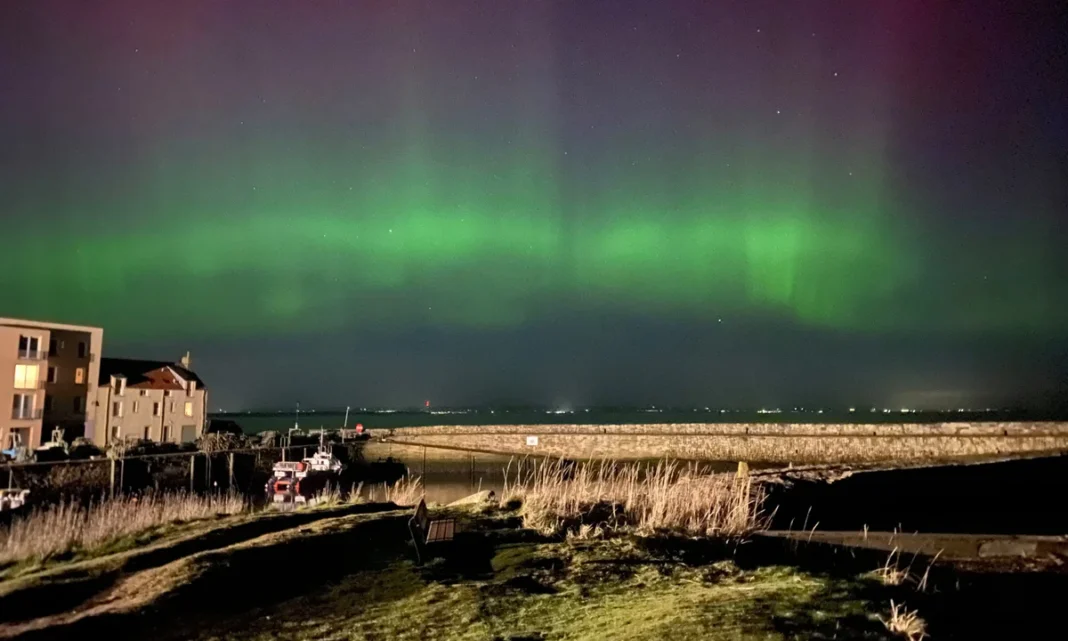
The Northern Lights are set to light up parts of the UK again on Wednesday night. Forecasters suggest the aurora could remain visible into Thursday morning. This follows sightings earlier in the week, when the aurora appeared across northern regions on Tuesday night.
The Met Office issued an alert on social media, saying the lights were “most likely across northern Scotland” but could be seen further south in Northern Ireland, England, and Wales. However, widespread cloud cover may limit visibility in these areas.
According to forecasters, the best viewing will be in northern regions, although there is still a chance of sightings further south. Remote locations with clear skies offer the ideal conditions for spotting the Northern Lights. Light pollution, cloud cover, and even the moon’s position can affect visibility.
The aurora occurs when coronal mass ejections (CMEs) erupt from the Sun and reach Earth. These high-speed solar eruptions interact with the planet’s magnetic field, causing geomagnetic storms that produce the colourful light displays in the sky.
The British Geological Survey explains that the colour of the Northern Lights depends on the molecules affected. Oxygen, nitrogen, and other atmospheric gases produce the range of blues, greens, yellows, and reds visible in the aurora.
Photographers captured pink and green rays from the Northern Lights over St Mary’s Lighthouse in Whitley Bay on Tuesday night. Experts recommend using a camera to help see the lights more clearly. The Royal Photography Society advises finding a “dark skies” location with minimal wind and low light pollution.
They also suggest adding foreground elements, such as trees for silhouettes or water to create reflections. Experimenting with strobe or LED lighting can enhance details in the foreground.
The aurora is typically most active during the Equinox and Solstice periods, which occur around March, April, September, and October. However, geomagnetic activity from CMEs can produce impressive displays at other times of the year as well.
For those hoping to catch the spectacle, patience and preparation are key. Observing the Northern Lights in a clear, remote location offers the best chance to experience one of nature’s most beautiful phenomena.
For more updates on this story, stay tuned to London Pulse News.