
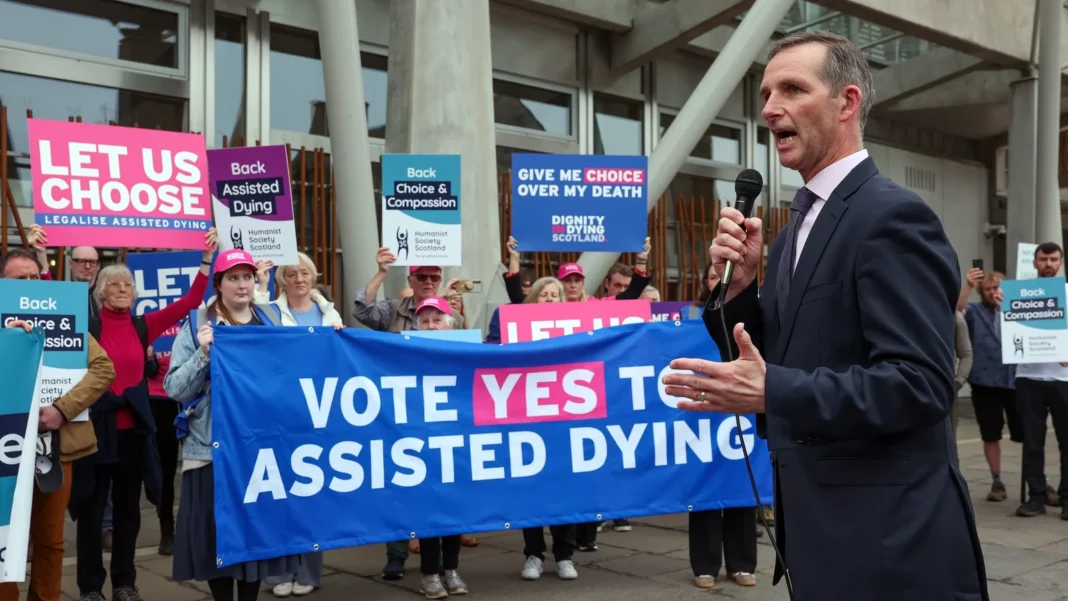
Members of the Scottish Parliament will vote on whether to legalise assisted dying in Scotland after one of the most emotionally charged debates in its history.
MSPs are due to hold the decisive vote at around 10pm on Tuesday on a Bill introduced by Liam McArthur. The proposal would allow terminally ill adults with mental capacity and less than six months to live to seek medical help to end their lives.
The legislation marks the most advanced attempt yet to legalise assisted dying at Holyrood. Previous efforts by Margo MacDonald and Patrick Harvie failed, while Jeremy Purvis did not secure enough support to introduce a similar Bill in 2004.
MSPs have spent weeks examining the proposal in detail. They debated late into the night and approved 175 amendments. One key change reduced the expected life expectancy requirement from 12 months to six months.
Despite that scrutiny, concerns remain over the Bill’s cost and the strength of its safeguards. Some MSPs who backed the proposal in principle last year say they may now vote against it at the final stage.
If passed, the Bill would allow eligible patients to request assistance to end their own life. MSPs will vote freely, without party instructions, and have been urged to follow their conscience.
Under the proposed law, two doctors must independently confirm that a patient is terminally ill and has the mental capacity to decide. Applicants must have lived in Scotland for at least 12 months and be registered with a GP. A minimum two-week waiting period would apply, and the patient must take the life-ending medication themselves.
Several medical organisations have raised concerns. The Royal College of Psychiatrists said recent changes have weakened safeguards for clinicians. The Royal Pharmaceutical Society has also expressed opposition.
Supporters argue the Bill offers dignity and choice. Opponents warn it could expose vulnerable people to pressure.
Speaking ahead of the vote, McArthur said the legislation provides “compassionate choice” alongside clear protections. He urged MSPs to back the Bill.
The debate has also highlighted deeply personal experiences. Some people with terminal illness support the change, saying it would give them control at the end of life. Others fear it could lead people to choose death during periods of despair or vulnerability.
If MSPs pass the Bill, it will allow adults aged 18 and over with terminal illness to apply for assisted dying. Doctors would also be required to inform patients of alternatives, including palliative care, and could opt out on conscience grounds.
The move comes as similar legislation in United Kingdom remains unresolved. A separate Bill for England and Wales, introduced by Kim Leadbeater, has stalled in the House of Lords.
Currently, assisted suicide remains illegal in England, Wales and Northern Ireland. In Scotland, it is not a specific offence, but those involved can still face serious criminal charges.
The outcome of Tuesday’s vote could mark a historic shift in how Scotland approaches end-of-life care.
For more updates on this news, follow London Pulse News.