
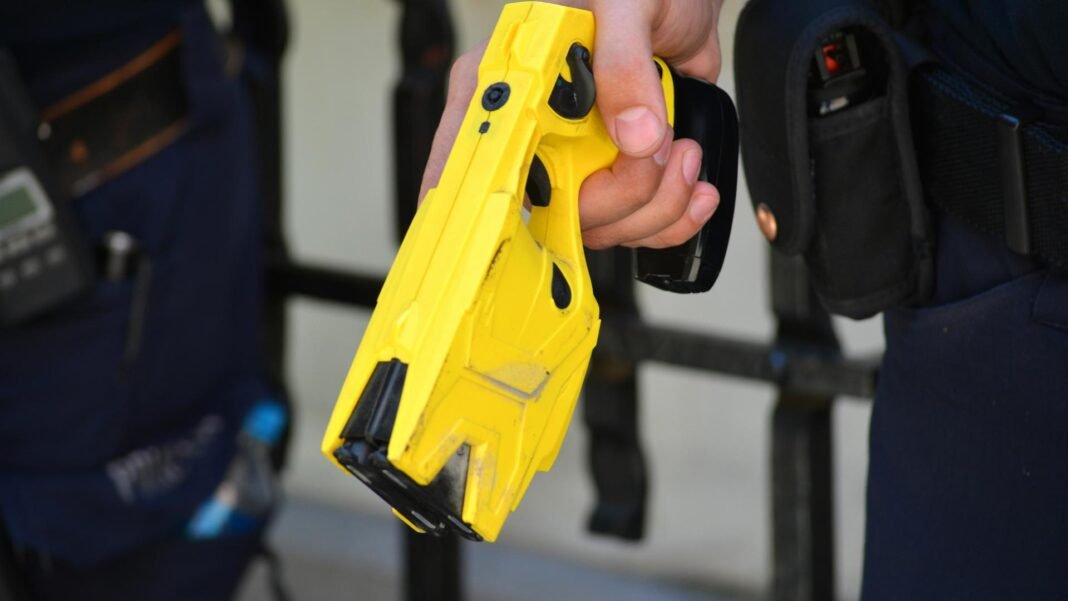
The Taser rollout in prisons has officially started as part of a government crackdown on record levels of assaults against officers. Specialist prison staff in England and Wales will now carry stun guns. This trial aims at reducing violence in male jails.
Justice Secretary Shabana Mahmood announced the Taser rollout in prisons after assaults on staff surged by 13% last year. The pilot will first equip officers from the Operational Response and Resilience Unit in Kidlington and Doncaster with Taser 7 devices. “We’re facing unacceptable levels of violence,” Mahmood said. “I’m determined to keep prison staff safe. This trial is a crucial step.”
The move follows several brutal attacks on officers. One incident involved Manchester Arena plotter Hashem Abedi, who injured four staff with boiling oil. In another case, an inmate allegedly scalded an officer with boiling water at HMP Belmarsh. Prison unions welcomed the Taser rollout in prisons but urged the government to address root causes like overcrowding and drug smuggling. “Tasers help, but we need long-term solutions,” a Prison Officers’ Association spokesperson said.
While prison staff unions have cautiously supported the Taser rollout in prisons, some criminal justice reformers have raised concerns. Advocacy groups warn that increased use of force could escalate tensions and disproportionately impact vulnerable inmates. These include those with mental health issues. “We need to balance staff safety with humane treatment of prisoners,” said a spokesperson for the Prison Reform Trust.
The Taser 7 delivers 50,000 volts on firing but drops to 1,500 volts on contact, temporarily incapacitating targets. Officers will carry them visibly as a deterrent, with each deployment reviewed for accountability. The trial is part of a £40 million security package, including anti-drone measures and body armor for high-risk units. If successful, Tasers could expand to more prisons by autumn.
For more political updates, visit London Pulse News.