
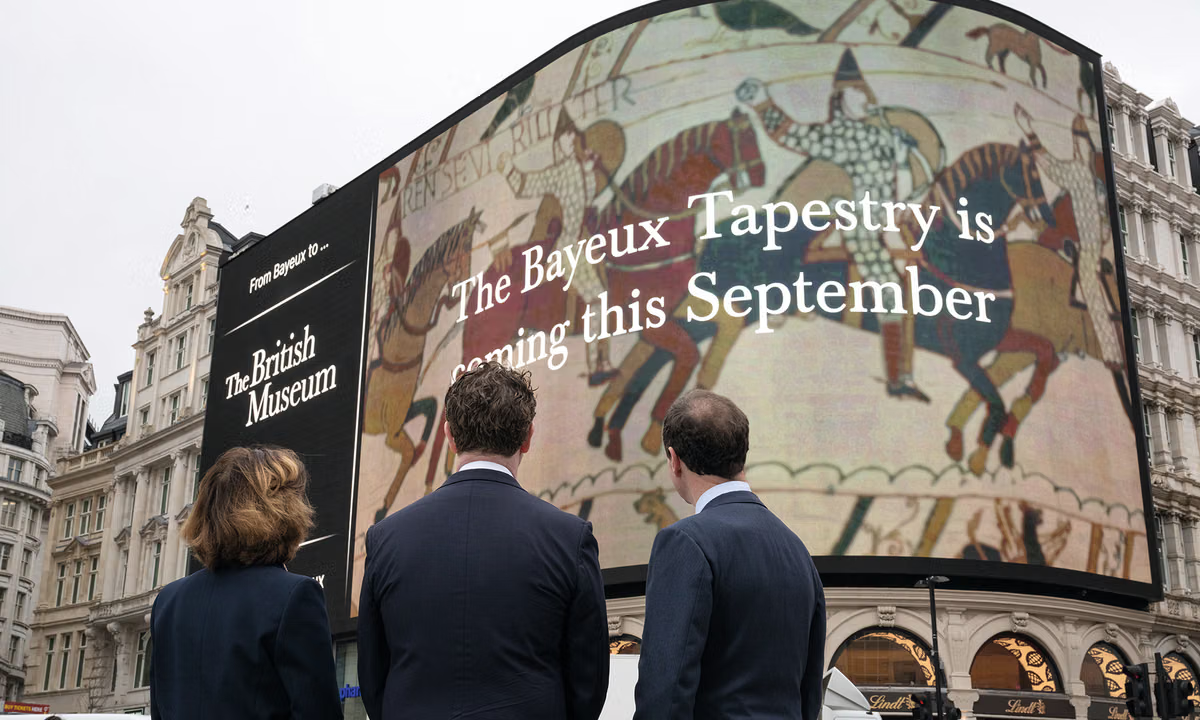
The Bayeux Tapestry has returned to England for the first time in almost 1,000 years. The British Museum will open its major exhibition on September 10.
The nearly 70-metre-long embroidery tells the story of the Norman Conquest of England. It remains one of Europe’s most important medieval artworks.
King Charles III, UK Prime Minister Andy Burnham and French President Emmanuel Macron attended a special preview in London this week.
The exhibition has already attracted huge interest. The first group of tickets sold out within hours. Around one million people could visit before the exhibition closes on July 11, 2027.
Here are ten surprising facts about the famous embroidery.
1. It is not actually a tapestry
People commonly call it the Bayeux Tapestry. However, the work is technically an embroidery.
Artists stitched dyed wool onto linen to create 58 scenes. Together, the scenes stretch about 68.3 metres.
2. London will display it flat
The British Museum will display the Bayeux Tapestry horizontally. This choice helps reduce pressure on the fragile textile.
The museum in Bayeux plans to display it at a 60-degree angle after conservation work.
The French government required the London exhibition to keep the embroidery flat. Conservation experts did not have enough time to prepare it for angled display.
3. Its early history remains a mystery
Historians know very little about the tapestry’s first 400 years.
The earliest known record dates to 1476. A Bayeux Cathedral inventory mentioned the work and said workers displayed it around the cathedral nave once a year.
Researchers still cannot confirm where it stayed before that period.
4. People once unrolled it for visitors
The tapestry spent much of the 19th century in Bayeux town hall.
From 1812 to 1842, staff kept it rolled around a large spool. They unrolled it on a table whenever visitors wanted to see it.
Modern conservation practices now treat the fragile embroidery much more carefully.
5. The ending may be missing
Visitors may think the exhibition shows the complete work. However, experts believe about three metres could have disappeared.
The tapestry may also have lost part of its beginning.
The missing section probably showed events before William the Conqueror’s coronation on Christmas Day in 1066.
6. Harold’s famous arrow may not be an arrow
One of the tapestry’s best-known scenes shows King Harold with an object near his eye.
Many people identify it as an arrow. However, an old engraving from 1729 appears to show a spear instead.
A 19th-century restoration may have changed the object’s position. Experts also cannot prove that the man shown actually represents Harold.
7. It shows Halley’s Comet
The Bayeux Tapestry contains one of the earliest European images of Halley’s Comet.
The comet appeared in April 1066, shortly after Harold became king.
People at the time viewed the comet as a warning of disaster. The embroidery therefore included it in the story surrounding Harold’s reign.
8. The Nazis wanted to take it to Germany
Nazi officials considered the Bayeux Tapestry important to their version of Germanic history.
During World War II, French officials moved the embroidery several times to protect it.
Heinrich Himmler later ordered German forces to take it to Germany. However, the order came too late.
The tapestry remained in Paris and returned safely to Bayeux in March 1945.
9. This is its first journey to Britain
The Bayeux Tapestry has never previously travelled abroad.
British institutions tried to borrow it several times between 1931 and 1980. Each attempt failed.
The latest project began with informal discussions in 2008. Serious plans followed in 2018.
The British Museum will also lend Sutton Hoo treasures and Lewis chess pieces to museums in Normandy.
10. The tapestry carries an enormous insurance value
The British Museum secured an indemnity of about £800 million for the loan.
The exhibition also represents the museum’s most expensive exhibition to date.
Ticket demand has already proved strong. The first ticket release reportedly generated around £2.5 million in revenue.
The exhibition could attract about one million visitors before it closes in July 2027.
The Bayeux Tapestry tells the story leading to the Battle of Hastings in 1066. William the Conqueror invaded England and defeated King Harold.
The embroidery likely came from England, possibly Canterbury. Historians believe workers created it during the early 1070s.
Bishop Odo of Bayeux may have commissioned the work. He appears prominently throughout several scenes.
The tapestry will return to Bayeux in late July 2027. Conservation work will then prepare it for the museum’s reopening in October 2027.
The Bayeux Tapestry will remain a major historical symbol as it approaches its 1,000th anniversary.